


The Tłı̨chǫ Government, Yellowknives Dene First Nation, and the Government of the Northwest Territories are partnering to shape the governance and ownership
framework for the AESC. Together, they are connecting immediate economic supports with new and long-term opportunities for Northerners, businesses and communities, while reinforcing Canada’s sovereignty and security, and the NWT’s critical minerals and supply chains.
The AESC project would provide all-season road access to the Nunavut border, with potential to connect to the proposed Grays Bay Port and Road Project.
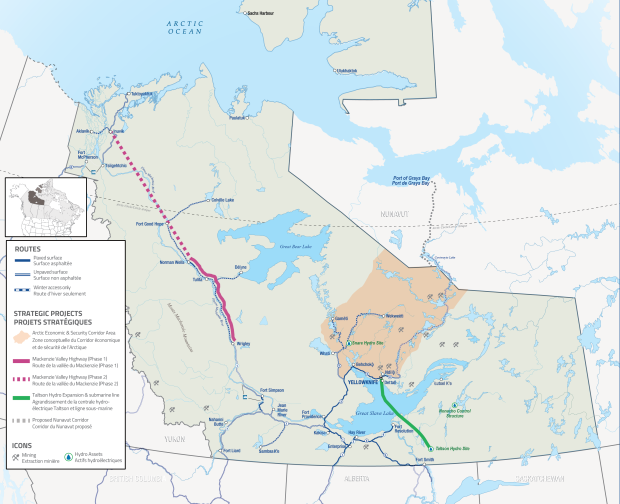
Anticipated Benefits
- Unlock access to significant critical mineral deposits essential to the global clean energy transition.
- Increase mineral exploration and development, including the nineteen critical minerals found in this region.
- Lower transportation and energy costs for northern industries and communities.
- Improve year-round reliability of transportation and supply routes.
- Create new opportunities for Indigenous and northern employment and business participation.
- Supported by the Taltson Hydro Expansion, the corridor could help deliver clean, reliable energy to northern communities and industries while reducing reliance on diesel.
- Strengthen Arctic defence and national sovereignty by enhancing Canada’s long-term presence and connectivity in the North.
Current Status
- In March 2026, the AESC was referred to Canada's Major Projects Office.
- In January 2026, the GNWT, Tłı̨chǫ Government, and Yellowknives Dene First Nation signed a Memorandum of Understanding to advance collaborative planning for the corridor and affirm Indigenous leadership.
- In September 2025, the AESC was identified by Canada as a potentially transformative early-stage initiative to support northern infrastructure, critical mineral development, and Arctic security.
- Work is ongoing to advance governance development, technical studies, and engagement to support environmental, engineering, and socio-economic assessments.
Next Steps
- 2026: We are working with the Major Projects Office to advance nation-building projects faster and more responsibly to help connect our economy, diversify our industries and trade, and create high-paying careers for generations to come.
- 2026: Continued Indigenous engagement and project definition work.
- 2026: Submission of project assessments, refinement of corridor routing, and determination of governance and ownership models.
- 2026–2028: Review processes and identification of construction funding opportunities.
- Ongoing: Update project design, business case, and costing estimates to support federal partnership and investment.
MOU
The Tłı̨chǫ Government, Yellowknives Dene First Nation, and Government of the Northwest Territories signed a memorandum of understanding for advancing the Arctic Economic & Security Corridor.