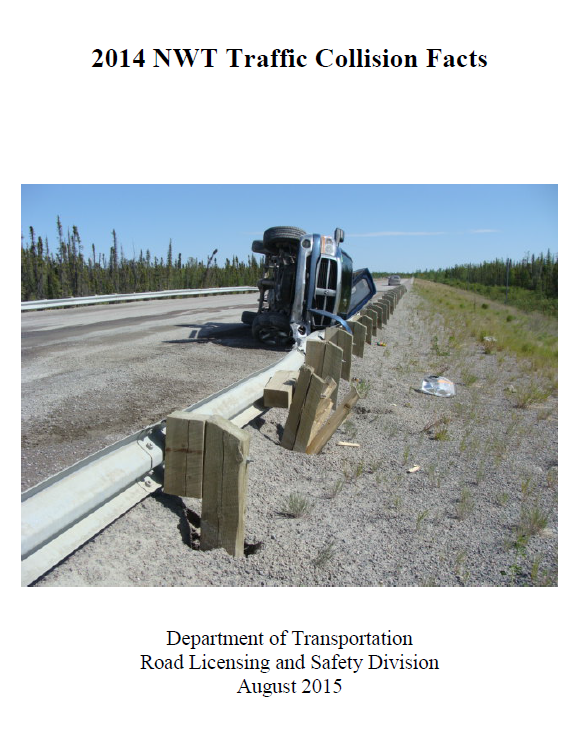
This report presents traffic data collected by the Department of Transportation on the territorial highway network from 1993 to 2015. This report includes traffic information collected on major highways, access roads, winter roads and associated ferry crossings. The report also contains information on vehicle classifications.
This publication contains useful information on issues such as - drinking and driving, unsafe speed, young and old drivers, and use of occupant restraints - that affect crashes and their severities. This report is organized in twelve sections. The contents of each section are described below.
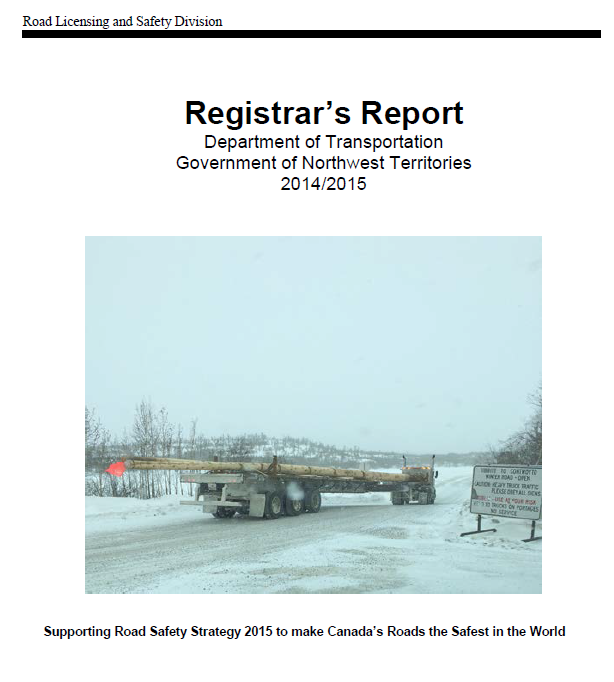
This report presents a statistical summary of the vehicle and driver population in the Northwest Territories and presents a summary of revenue, driver testing activity, convictions and suspensions. This information can be used by Program Managers, Regional Superintendents and Senior Managers to assess Road Licensing and Safety activities and monitor trends. The information in this report is derived from data maintained on the Road Licensing and Safety Motor Vehicle Information System (MVIS). A series of reports are used to extract the statistical information from MVIS.
The following business case presents an opportunity for Canada and the GNWT to
further collaborate in the construction of a 321 kilometre section of highway from
Wrigley to Norman Wells in the Central Mackenzie Valley. The Project would further
assert Canadian sovereignty in the North by providing reliable access into a relatively
isolated region of the territory, incentivizing resource exploration and development of
the rich petroleum reserves of the region, and promoting social and economic
opportunities for residents of the NWT and Canada. It is estimated that 14,082 jobs
within the NWT and the rest of Canada will be created during the construction phase of
the project, while 161 long-term jobs are expected to be created for the operation and
maintenance phase.
The purpose of the NWT Road Safety Plan (RSP) is to guide the department’s road safety programs over the next four years in a manner that is collaborative, structured, and focused on the goal of reducing fatalities and injuries on our community roads, winter roads, ice crossings, highways, and trails.